All of us readers know that reading any one book or seeing a film can be the engine for all the other cars in a summer reading train.
Questioning the truthfulness of the biography of Harper Lee reminded me of Oprah's famous interview with James Frey after the publication of A Million Little Pieces. The book was, as I recall, excellently written, but after she'd promoted it and pushed it to the top of the NYT best seller's list, it came out that it wasn't, in fact, a memoir, as it had been marketed.
Frey appeared on her show--and felt "ambushed" when she accused him of lying. A memoir, by definition, should tell the truth.
I Googled that interview and came up with a subsequent conversation with Oprah and Frey that was interesting and illuminating.
https://www.youtube.com/watch?v=eYRQ_ZY1YoA
While Frey admits that he was hurt by the interview that we all saw in 2003, he doesn't cast blame and doesn't admit to being angry at Oprah, per se. Even if he had known it was going to be the "one man car wreck" that it was, he says he would still have appeared on the show. He doesn't blame Oprah; he takes full responsibility for shopping the book as memoir when he hadn't actually written it as such.
American Masters has just produced a show on PBS, by the way, that is a much better reflection of Harper Lee's work than the one I just read. It airs this week on Georgia Public Radio, but not on KLRN. I look forward to seeing it when it airs locally.
Thursday, July 16, 2015

The Mockingbird Next Door
I've been reading The Mockingbird Next Door by Marja Mills off and on this week--and I heartily do not recommend this book.
I was telling Carlene this morning as we were driving to McDonalds for our morning drinks that I suspected that it was not approved by Harper Lee--and sure enough, I read on the Internet this morning that she did not.
Unlike the wonderful book, My Life in Middlemarch (that I wrote about earlier), this is a book that lacks substance. I could have probably written it, little as I know about Harper Lee!
Supposedly Marja Mills was a writer for the Tribune and she moved to Monroeville, Alabama, to get to know Harper (called Nellie by her friends) and her sister Alice (who practiced law as their father did in Monroeville.)
But the book is much throat-clearing and repetition of facts, and it doesn't reveal any conversations of substance. In the end, we know more about Marja, her personality, and her lupus than we get to know about Harper Lee. And yet the book--due to much curiosity about the Lees--is on the New York Times Best Seller list.
There is much interest in the South this summer--what with Lee's Go Set A Watchman's release, the events in South Carolina, and all the talk about racial relations in the South. But this is not the book to read to find out more about the author or Monroeville, Alabama.
I was telling Carlene this morning as we were driving to McDonalds for our morning drinks that I suspected that it was not approved by Harper Lee--and sure enough, I read on the Internet this morning that she did not.
Unlike the wonderful book, My Life in Middlemarch (that I wrote about earlier), this is a book that lacks substance. I could have probably written it, little as I know about Harper Lee!
Supposedly Marja Mills was a writer for the Tribune and she moved to Monroeville, Alabama, to get to know Harper (called Nellie by her friends) and her sister Alice (who practiced law as their father did in Monroeville.)
But the book is much throat-clearing and repetition of facts, and it doesn't reveal any conversations of substance. In the end, we know more about Marja, her personality, and her lupus than we get to know about Harper Lee. And yet the book--due to much curiosity about the Lees--is on the New York Times Best Seller list.
There is much interest in the South this summer--what with Lee's Go Set A Watchman's release, the events in South Carolina, and all the talk about racial relations in the South. But this is not the book to read to find out more about the author or Monroeville, Alabama.
Tuesday, July 14, 2015
Nathan and Elena Visit Nana's Country
Elena usually refers to my neighborhood as "Yenna's Country"--but last night, it was also Nana's.
Along with their parents, Nathan and Elena came over yesterday for the day and evening, finding Nana's room (and the contents of it) of great interest.
At one point, Elena came into the room where the adults were sitting, waving a quite personal item of Nana's in her hand: "Nana, is this yours?"
"It is," Nana said, laughing. "And I'd appreciate your putting it back where you found it."
When I went into Nana's room to see what they were up to, Elena asked me to hurry and help her zip up Nana's little yellow bag filled with four little bottles of eye drops "so I won't get in trouble...."
Using seven or eight of the dolls from my collection, Nathan made up a play loosely based on the Paddington movie. Judy (whose voice I tried to give a proper English accent) was moving to Paris, but I was to direct her back to England after three days, saying that she didn't like it there after all because nobody would talk to her.
So far, Elena has expressed little interest in the Madame Alexander dolls, but Nathan is always fascinated by them as props in his improv productions. Last night, English Judy and Jonathan ordered three breakfast tacos from the All-American car hop doll--possibly the first tacos delivered on roller skates?
Elena prefers writing letters on index cards, folding them up, and delivering them to the rest of us, saying, "Special De-Livery." Sometimes she tells me the words to write, but mostly she draws squiggles and the receiver figures out the meaning. "We just write letters to each other telling each other we love them," Nathan said.
 |
| At the Saturday Night rodeo |
Along with their parents, Nathan and Elena came over yesterday for the day and evening, finding Nana's room (and the contents of it) of great interest.
At one point, Elena came into the room where the adults were sitting, waving a quite personal item of Nana's in her hand: "Nana, is this yours?"
"It is," Nana said, laughing. "And I'd appreciate your putting it back where you found it."
When I went into Nana's room to see what they were up to, Elena asked me to hurry and help her zip up Nana's little yellow bag filled with four little bottles of eye drops "so I won't get in trouble...."
Using seven or eight of the dolls from my collection, Nathan made up a play loosely based on the Paddington movie. Judy (whose voice I tried to give a proper English accent) was moving to Paris, but I was to direct her back to England after three days, saying that she didn't like it there after all because nobody would talk to her.
So far, Elena has expressed little interest in the Madame Alexander dolls, but Nathan is always fascinated by them as props in his improv productions. Last night, English Judy and Jonathan ordered three breakfast tacos from the All-American car hop doll--possibly the first tacos delivered on roller skates?
Elena prefers writing letters on index cards, folding them up, and delivering them to the rest of us, saying, "Special De-Livery." Sometimes she tells me the words to write, but mostly she draws squiggles and the receiver figures out the meaning. "We just write letters to each other telling each other we love them," Nathan said.
 |
| Nathan and two members of his "Coming Home From Paris" cast. The Tin Man is "Metal-top"--the robot built by Jonathan Brown while Paddington is visiting their home. Metal-Top's specialty is bringing people back from the dead. |
 |
| Elena working on the house and other props |
Taking pictures
Two friends of mine are writing a book--and I've been asked to be the photographer, amateur that I am!
It's an exciting project that I'll tell you more about when I get permission to do so--but for now, I'll just say that I'm looking forward to taking some pictures for a book about an intriguing topic.
Tonight, we're going over to Freda's to watch a movie and have dinner. Bonnie Lyons came over for a fun visit this morning. Carlene and I had both read her wonderful newest book of poems, SO FAR, and she brought Carlene an autographed copy.
Here's one of my favorites:
LOVE POEM
William Stafford said
write a poem every day
just sit down and write
a bad poem if necessary.
But how can I write
a poem when I don't know
many fish or flowers
stars or snakes
when I can't roll the names
(leafy sea dragon!)
around in my mouth
like complex wines?
I thought the problem was
I couldn't write a poem.
Maybe the problem is
I don't love enough.
It's an exciting project that I'll tell you more about when I get permission to do so--but for now, I'll just say that I'm looking forward to taking some pictures for a book about an intriguing topic.
Tonight, we're going over to Freda's to watch a movie and have dinner. Bonnie Lyons came over for a fun visit this morning. Carlene and I had both read her wonderful newest book of poems, SO FAR, and she brought Carlene an autographed copy.
Here's one of my favorites:
LOVE POEM
William Stafford said
write a poem every day
just sit down and write
a bad poem if necessary.
But how can I write
a poem when I don't know
many fish or flowers
stars or snakes
when I can't roll the names
(leafy sea dragon!)
around in my mouth
like complex wines?
I thought the problem was
I couldn't write a poem.
Maybe the problem is
I don't love enough.
Saturday, July 11, 2015
The Letter B--and other letters
It occurred to me, traveling, that I'm always drawn to B things: Bags, boxes, bowls, baskets, and books. These are the things I shop for and discover and bring home.
I like my life to be alliterative.
At some point in West Louisiana, Carlene noticed a store: Beer, Bait, and Beyond.
On another stretch of road, I wish we had actually counted the tiny Baptist churches that were, seemingly, around every bend: Bethany Baptist, Beulah Baptist, Bella Vista Baptist--just to name a few of the "B" names. For miles, it was as if every small community had its own Baptist church and my guess is that the maximum size of congregation would be around 40 or 50 members.
In Lufkin, Texas, we stopped for a drink at Whataburger and asked directions to the post office: "Just keep going thataway," the girl told us. "Pass houses, houses, houses, then buildings, buildings, buildings. Then look over thataway [she pointed to the right side of the street in her mind] and you will see a great big building with steps steps steps and that will be the post office." We followed her odd directions and, sure enough, we found the post office--though it wasn't all that big.
This morning Carlene and I are reading the books we bought in Oxford and enjoying the quiet of the first morning at home, interrupting the silence from time to time to read each other lines from the book we're reading. She's reading a book about Harper Lee: The Mockingbird Next Door and a preview of Lee's recently published Go Set A Watchman.
I am reading the book she bought for me--a series of letters between Eudora Welty and William Maxwell: What There Is to Say We Have Said.
We'd planned to walk three miles and start our healthier eating regimen, but Urth Juice wasn't open yet--so we decided to have a bowl of cereal and spend the day relaxing at home before the rodeo tonight.
I like my life to be alliterative.
At some point in West Louisiana, Carlene noticed a store: Beer, Bait, and Beyond.
On another stretch of road, I wish we had actually counted the tiny Baptist churches that were, seemingly, around every bend: Bethany Baptist, Beulah Baptist, Bella Vista Baptist--just to name a few of the "B" names. For miles, it was as if every small community had its own Baptist church and my guess is that the maximum size of congregation would be around 40 or 50 members.
In Lufkin, Texas, we stopped for a drink at Whataburger and asked directions to the post office: "Just keep going thataway," the girl told us. "Pass houses, houses, houses, then buildings, buildings, buildings. Then look over thataway [she pointed to the right side of the street in her mind] and you will see a great big building with steps steps steps and that will be the post office." We followed her odd directions and, sure enough, we found the post office--though it wasn't all that big.
This morning Carlene and I are reading the books we bought in Oxford and enjoying the quiet of the first morning at home, interrupting the silence from time to time to read each other lines from the book we're reading. She's reading a book about Harper Lee: The Mockingbird Next Door and a preview of Lee's recently published Go Set A Watchman.
I am reading the book she bought for me--a series of letters between Eudora Welty and William Maxwell: What There Is to Say We Have Said.
We'd planned to walk three miles and start our healthier eating regimen, but Urth Juice wasn't open yet--so we decided to have a bowl of cereal and spend the day relaxing at home before the rodeo tonight.
Friday, July 10, 2015
Mike's Tie Chair

One day last week, Mike brought out a big bag of silk ties to make a seat and back for this old rocker.
I did the weaving of the seat, and today he sent me this picture of the finished rocker--which I think is totally beautiful!
He'd planned to refinish his boat today, but found a nest of birds already living quite happily inside it, so he deferred to their dwelling choices and postponed his project.
Home again....
Carlene and I arrived home about 7:00, exhausted, after one of our best road trips ever.
We stayed in the hotel this morning to watch the CNN reporting of the taking down of the Confederate flag in South Carolina. That flag had only been there since the early 1960s, and it was intended for display only during the year of the Centennial--but somehow it never was removed. South Carolinians have been debating the issue or keeping it or taking it down for many years, and thousands of people assembled this morning to watch it being removed from the capitol grounds.
As we've traveled together through the Deep South, we've taken the time to watch films and read about the history of Natchez and the Natchez Trace--stimulating conversations about the meaning of the Confederate flag and the Southern psyche.
I learned that my two great-grandfathers fought in the same battle in Gettysburg. One was an Alabama farmer, the other a Georgia farmer--neither slaveholders. Ironically, the two soldiers were just a few feet apart at one of the bloodiest battles of the War. Both were captured, both survived--and, as far as I know, they didn't know each other. Had either man died in that battle, our family tree would not have sprouted the branch on which I live.
It's mind-boggling to think of how such strokes of luck or good fortune (or the opposite) determine who gets to be born and have a life. All of us alive today are descendants of survivors of wars.
In eighth grade, Betty and I read Yankee Stranger, Gone With the Wind, and other historical novels about the Civil War, but I don't recall ever studying the war in school beyond a cursory coverage of dates and place names. The impact of that war is felt in the trajectories of our lives, both Northerners and Southerners.
When asked why there are so many good writers in the South, Walker Percy said, "Because we lost the war."
I learned that my two great-grandfathers fought in the same battle in Gettysburg. One was an Alabama farmer, the other a Georgia farmer--neither slaveholders. Ironically, the two soldiers were just a few feet apart at one of the bloodiest battles of the War. Both were captured, both survived--and, as far as I know, they didn't know each other. Had either man died in that battle, our family tree would not have sprouted the branch on which I live.
It's mind-boggling to think of how such strokes of luck or good fortune (or the opposite) determine who gets to be born and have a life. All of us alive today are descendants of survivors of wars.
In eighth grade, Betty and I read Yankee Stranger, Gone With the Wind, and other historical novels about the Civil War, but I don't recall ever studying the war in school beyond a cursory coverage of dates and place names. The impact of that war is felt in the trajectories of our lives, both Northerners and Southerners.
When asked why there are so many good writers in the South, Walker Percy said, "Because we lost the war."
Waking up Thursday Morning Beside the Mississippi River
Carlene and I are having such a relaxing trip--great food and lodging and meeting good people along the way. Her friends say Carlene can talk to a brick wall, and she can. Whenever the subject of age comes up, the person looks at her with disbelief, which she justifiably enjoys! "Ninety!" they all say. "I hope I'll be like you when I'M ninety!"

This was our view of the Mississippi Bridge Wednesday night--from the deck of the Comfort Suites in Vidalia, Louisiana. Across the bridge is Natchez, Mississippi--where we had a delicious dinner and returned Thursday morning to explore.

 |
| Carlene loves bread pudding |

The drive to Natchez was beautiful on Highway 61 from Oxford. Lush farm land and miles of soybean, corn, rice, and cotton remind me of where so many of our foods and fabrics come from. The towns we dipped into between Oxford and Natchez were economically depressed, and it was sobering to see them. Most small towns--including Clarksdale, home of the Blues--had blocks of boarded up store fronts.
The main commerce in the small towns is utilitarian: Dollar Stores, tractor and farm equipment companies, and fast food. With few exceptions, the schools and playgrounds and dwellings are shabby and sad.
The Shack-Up Inn in Clarksdale is a collective of share-cropper cabins where travelers and music-lovers can stay--including two small cabins built out of silos. It's easy to see why this impoverished region of Mississippi is home of so much blues music.
 |
| The Shack Up Inn |
 |
| Silo Houses |
 |
| From a wall of names--B B King, Muddy Waters, Etta James, Lead Belly, and so many others |
 |
| Share-cropper cabins |
Her husband had decided to take his life after a cancer diagnosis (he didn't want to experience what his sister had just gone through), and so many people Charlotte knew had had cancer. I couldn't help wondering if there's a connection between the seemingly high rate of cancer in this area and the ever-present chemicals of crop dusting.
As the sun came up over Natchez, I thought of both the beauty and poverty that make up the South. With the constant news coverage of taking down the Confederate flag after the Charlestown tragedies, I'm thinking a great deal of the history of the South and the huge differences between the prosperous and the poor. I'm feeling a renewed interest in re-reading Southern writers--Faulkner and Welty and O'Connor and more contemporary ones.
Natchitoches is the oldest town in Louisiana, older than New Orleans. In the parish of Natchitoches we saw more tractors and more small churches than I've ever seen on any stretch of land. We walked yesterday on the hot brick streets of Natchitoches (built along the Cane River) and ate the famous Cajun meat and crawfish pies. History vibrates in the very air of the South, and you can taste it in the layers of flavors in the food.

Tuesday, July 7, 2015
Tuesday in Tupelo and Oxford, Mississippi
We woke up this morning in Tupelo and visited the Visitor's Center on the Natchez Trace--a 444-mile National Parkway that goes all the way from Nashville to Natchez. One day, we'd like to drive the entire parkway, but this time we drove only a little--as we want to get back to San Antonio in time for Elena's last rodeo of the season on Saturday.
We spent all day in Oxford--eating lunch at Bouré's on the square and spending a few hours in the Square bookstores. Good food, good company and good books--what a wonderful way to spend a day! We had tomato pie and catfish PoBoy--delicious!


Then we toured Rowan Oak--William Faulkner's home:
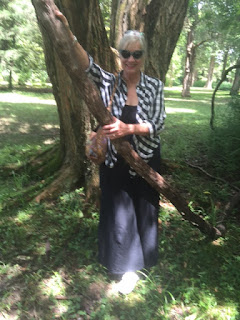

Faulkner died at the age of 64--having taken a nasty fall from a horse, complicated by his alcoholism.


In the evening, we discovered AJAX, another great place to eat on the square--and returned to the bookstores for one final browse:

We spent all day in Oxford--eating lunch at Bouré's on the square and spending a few hours in the Square bookstores. Good food, good company and good books--what a wonderful way to spend a day! We had tomato pie and catfish PoBoy--delicious!


Then we toured Rowan Oak--William Faulkner's home:


Faulkner died at the age of 64--having taken a nasty fall from a horse, complicated by his alcoholism.

Here are his words from his Nobel-Prize acceptance speech:


Sunday, July 5, 2015
Melba's Pound Cake
Yesterday, Carlene and I walked down the street to visit Melba and Bill--neighbors and friends since my parents moved to this neighborhood 50 years ago.
Bill (87) was at the point of death a few months ago, was even moved into a nursing home--but he's rallied. He still thinks he can do everything he used to do, but he's not as sure on his feet. Last week he fell beside the driveway and couldn't get up. Melba drove the car down the driveway to where he'd fallen and pulled him back into the car with the crook of his cane.
I recalled to Melba her recipe for Brunswick stew that is still in my box of wedding present recipes. She said, "Would you like my recipe for pound cake? Here--let me give you a piece and see if you like it." It was delicious.
Pound Cake
Blend well:
2 cups of sugar, 1 stick of oleo, 1 stick of butter.
Add:
2 cups cake flour, 4 eggs, 3 teaspoons vanilla flavoring.
Bake in a greased and floured tube pan at 350 for about 50 minutes.
Note: For Crust on Top--Add egg whites to blended butter/sugar with some flour. Slowly add rest of flour and egg yolks.
Bill (87) was at the point of death a few months ago, was even moved into a nursing home--but he's rallied. He still thinks he can do everything he used to do, but he's not as sure on his feet. Last week he fell beside the driveway and couldn't get up. Melba drove the car down the driveway to where he'd fallen and pulled him back into the car with the crook of his cane.
I recalled to Melba her recipe for Brunswick stew that is still in my box of wedding present recipes. She said, "Would you like my recipe for pound cake? Here--let me give you a piece and see if you like it." It was delicious.
Pound Cake
Blend well:
2 cups of sugar, 1 stick of oleo, 1 stick of butter.
Add:
2 cups cake flour, 4 eggs, 3 teaspoons vanilla flavoring.
Bake in a greased and floured tube pan at 350 for about 50 minutes.
Note: For Crust on Top--Add egg whites to blended butter/sugar with some flour. Slowly add rest of flour and egg yolks.
Subscribe to:
Posts (Atom)